
Filament Storage on the Cheap
The piles of filament have started getting a bit silly, and even though I have a filament dryer, it would be nice if I could grab a spool and print right away1. Plenty of people sell dedicated filament dry boxes, but the price would quickly add up for the couple of dozen rolls I already have in stock.
My constraints were:
- Cheap
- Airtight
- Fits on a shelf
My outgoing storage solution was a mix of vacuum bags2, some chocolate boxes, and just throwing loose rolls on the shelf.
The Boxes
After a recommendation from a colleague, I picked up a set of six KICHLY cereal containers. They’re BPA-free3 and airtight, and each box fits one full roll of filament. The price was right, so it was worth a punt.
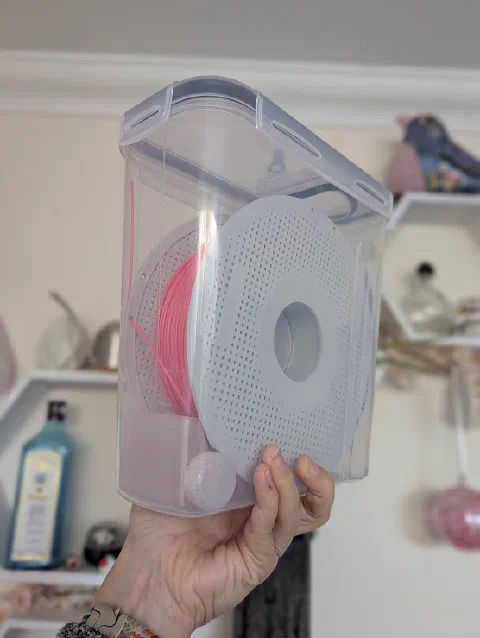
One roll per box, with the desiccant holder tucked in the corner
Keeping Them Dry
An airtight box only stops dampness moving in and out. If you put damp filament away, or open the box somewhere damp, the filament will still get wet, so you need something in there soaking it up. I went with Fonday silica gel beads, a 2lb tub of moisture-indicating beads that go from orange to green when they’re full. That means you can see at a glance when a box needs attention, and budget extra time for drying if needed.
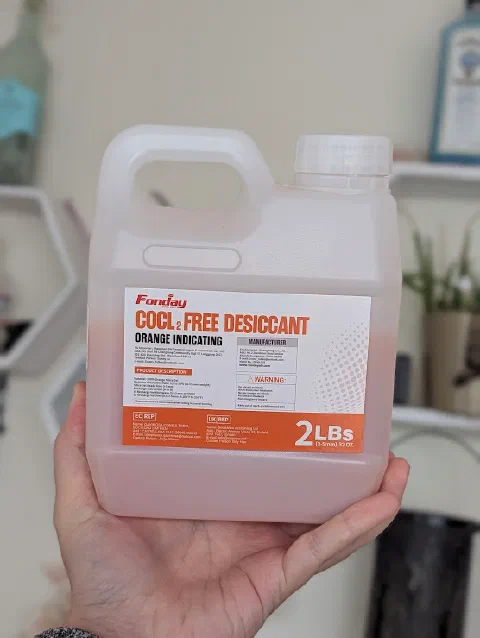
The beads are rechargeable, so once they’ve turned green they just need heating up to drive the moisture out. I’ve not had to do this yet, and previously with silica gel bags I’ve tried to microwave them with limited luck, so I think I will try just drying these in the oven when it comes to it.
The Desiccant Holder
The old silica gel sachets only held small amounts, so really I wanted a container to keep the loose beads in inside the cereal boxes. I have a 3D printer, so why not see if I can print something that fits the boxes nicely4?
A bit of googling later I found and printed a Corner Desiccant Holder for Dry (Cereal) Box by Xero. It’s a curved holder that sits in the corner of the box, out of the spool’s way, with a screw-on cap so you can tip the beads out to dry them.
This was printed on my trusty Bambu A1 Mini5, and each one takes a bit over 2h to print. If you are printing these yourself, note that printing them on the “side” with the cap facing the horizon led to better results than printing them on the base with cap facing the sky6.
I printed them in “clear” filament in the hope of seeing the beads change colour through the walls. It wasn’t super effective, as the printed walls come out more frosted than see-through, but at least it doesn’t hurt.
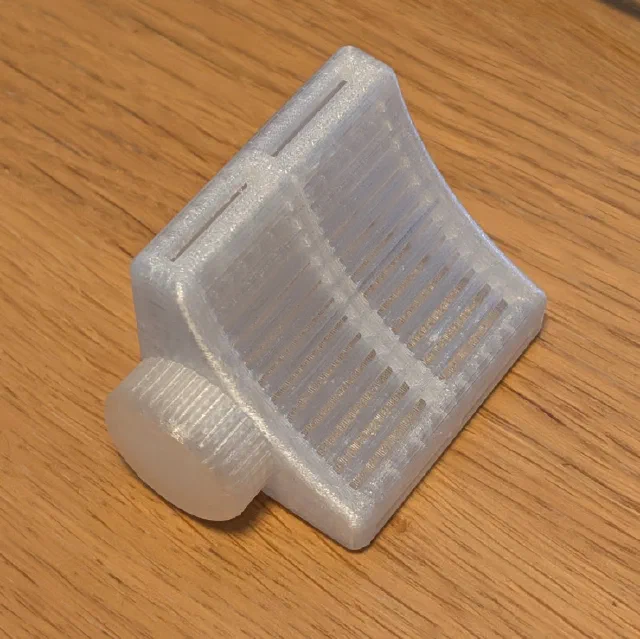
Fresh off the printer, before any beads went in
Final Thoughts
I’m still in the process of printing the desiccant holders, and I need a few more of the boxes, so only time will tell if this works well. The biggest downside of this process is the filament takes up a lot more space than before, so I’m going to have to move some shelves and have a tidy, but it should mean it’s easier to grab each roll.
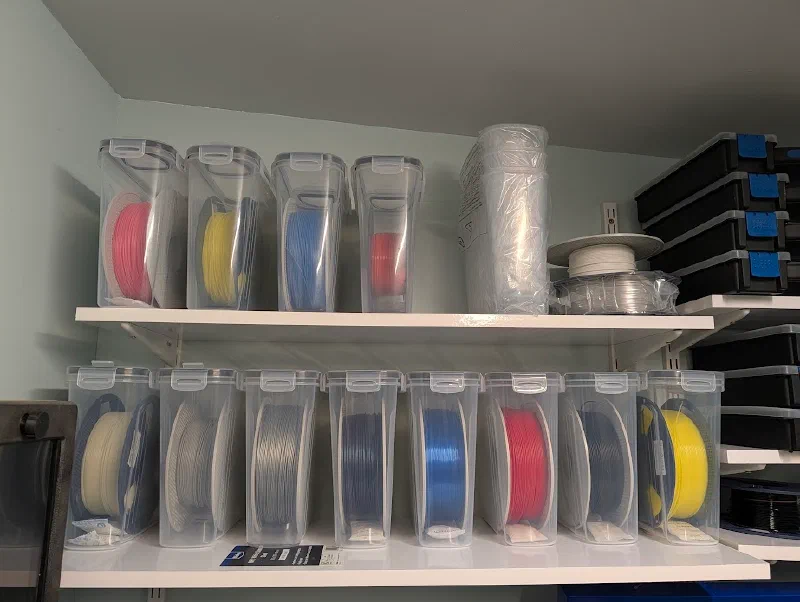
Twelve boxes in, and the shelves are already filling up
-
Filament soaks up moisture from the air, and wet filament prints badly. I’ve def noticed the PETG starting to string a bit more as the weather has changed. ↩︎
-
I’ve heard really good reviews of these, but I found I broke the seals pretty quickly, and often came back to bags that were no longer under vacuum. ↩︎
-
Not that that’s a massive issue for my use case… ↩︎
-
Friends did suggest jam jars with holes in the lids, which would have been cheaper still. ↩︎
-
The same printer has churned out a split flap display, a case for the emailkb and the Beg Button’s walk/stop light mount. ↩︎
-
Mostly due to the supports needed. It takes a little bit of work to clean up the threads where the supports reach them, but the internal supports then come out via the cap and only need handling on one side. ↩︎